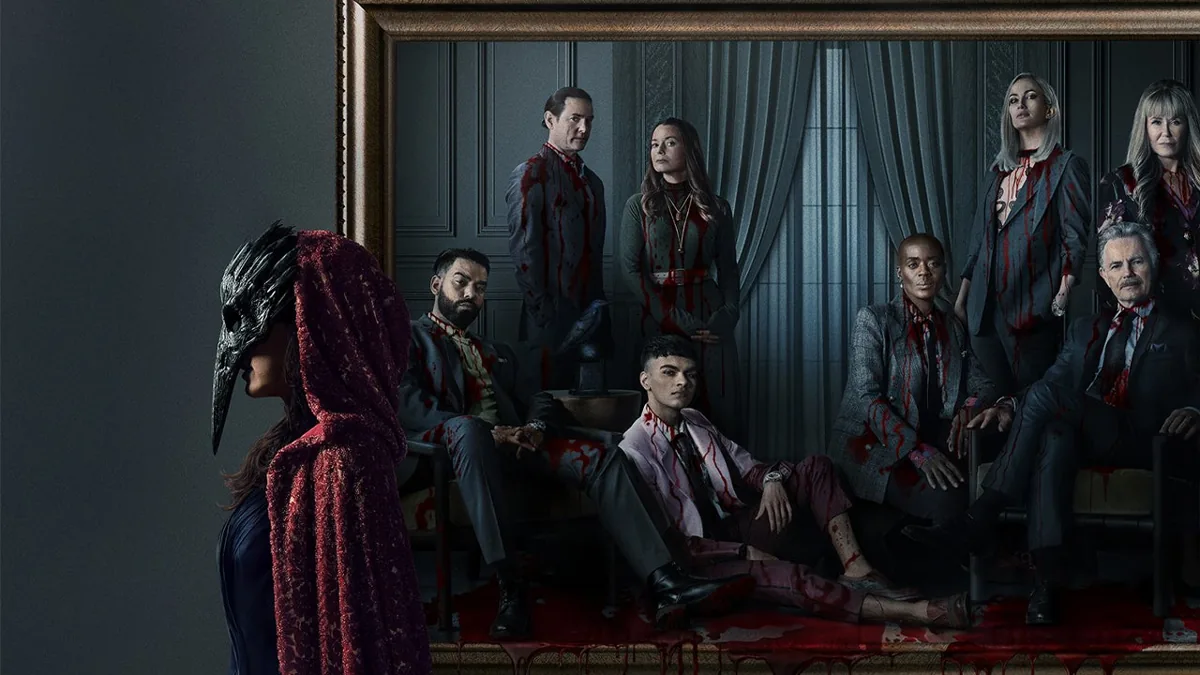
I’ve been trying to figure out why I’m so on again, off again with Mike Flannagan. I’ve seen, as far as I can tell, every single thing he has made to date.
- Meh Absentia
- Loved Occulus – a masterpiece
- Liked Before I Wake
- Loved Hush
- Meh Gerald’s Game
- Loved Doctor Sleep
- Loved, Loved, Loved the Haunting of Hill House
- Meh for Bly Manor
- Polarized by for Midnight Mass (loved the first half, meh the second half)
- Meh for Midnight Club
- Meh for Fall of the House of Usher
I don’t expect to like everything a director makes any more than I expect someone to like everything I write. We are artists and art is highly subjective. Something everybody likes is something nobody loves (or hates). The fact that I love a third of Mr. Flannagan’s work should be high praise IMHO, and I will continue to consume anything he makes for the rest of his life.
I had reasonable expectations for Fall of the House of Usher (FOTHOU). I thought the material was in good hands with Mike Flannagan (MF).
On paper, FOTHOU is a great pitch – Every episode pays homage to a particular story of Mr. Poe’s body of work, while the overall story is framed around FOTHOU. Sounds good.
On the surface, it’s hard not to see Netflix’s influence on the show – from the ‘Is it Cake’ reference early on to the characters literally watching Netflix on Netflix (hovering over Gerald’s Game, no less), to the general notion that FOTHOU is essentially a retelling of PAINKILLER, another Netflix show, on a Netflix show. Usher could have peddled anything, or it could have just been old money without a clear source, the well tainted by time and running dry. Nevertheless, they chose opioids as the vehicle to the Usher’s wealth, and that’s fine if a safe, unoriginal choice.
It’s not lost on me that Mike Flannagan is basically me – we’re both white, middle-aged men, married to loving women who support our work, and he is adapting things he loves and admires in a way that is faithful to the original that same way I hope to one day be in a position to do. Safe to say I may be a little jealous of his success. Again, on paper, FOTHOU really looks good.
Part of the issue, for me, is that when I think of Poe’s work, I think of words like macabre, dark and dreary, and gothic, and the show is none of those things for me. The show is mantic and bright and clean, I spend half the time with twice the characters I want to. The characters are flat archetypes, barely developed. I’m still not sure what Goldbug even was (and maybe that’s the point). I’ve seen these actors do so much more with their talents, and I can’t help but wonder where the problem stems; is it Netflix exerting too much control, which is why MF left, or is it MF exerting too much control, which is why the material feels so… flat.
There are some really clever ideas, though. The Tell-Tale Heart Pump was pretty clever, I must admit. And the Pit and the Pendulum episode was inventive.
I read an article where MF said, “… I got most of my religious horror out of my system in Midnight Mass,” And that singular sentiment actually helped me identify what I wasn’t jiving with.
When MF is telling a story that is character-focused, and goal-driven, with active, three-dimensional protagonists, I am fully engaged. I like the way he tells stories.
But when he gets up on a soapbox and preaches to the masses, whether that be religion, opioids, influencer culture, drugs, or whatever… it just reads like a man who quit drinking trying to make me feel bad about my vices. And the monologues he loves are the perfect hammer to beat against this particular anvil.
Now, to throw myself on the proverbial altar, a collaborator and I recently wrote a horror script that seeks to skewer Hollywood, celebrity, influencer culture, and the like in a horror satire, and our characters, likewise, can be a little cardboard at times, a little Archetype-y. But we are working under a different vehicle – feature film, where our real estate is much more limited. And for our main protagonist, we fought tooth and nail to make her a three-dimensional character, in theory, getting the best of both worlds – a strong, active heroine trapped in a horror nightmare.
That being said, with a team of writers and eight hours to flesh the story out, I was surprised by how bloated the story felt, how unengaged I was by any of the characters, and how the last few episodes in particular, felt like wading through a quagmire rather than being dragged into Usher’s personal hell. Surely I can’t be the only one in the world who feels this way?